Carson’s advice, however, has not gone unchallenged. Many critics have called her idea “impractical” or “absurd.” Rowan Dean of The Spectator Australia mocked it as “lefty lunacy”, while psychologist John Rosemond argued it fosters confusion rather than healthy family dynamics.
On social media, reactions ranged from humor to outrage. Some joked about asking pets for consent next, while others said a crying baby is already “consenting” to a diaper change. Many questioned Carson’s real-world experience, calling her idea out of touch with the realities of parenting.
Yet some parents and educators defended her point — saying that while babies can’t verbally say “yes” or “no,” the core principle of respect is worth embracing. They argue that Carson’s message isn’t literal, but a symbolic reminder to treat children as individuals with feelings and boundaries, even at infancy.
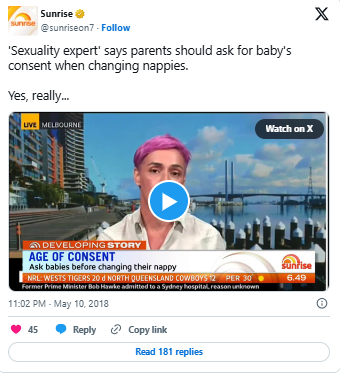
As the debate spreads, it raises larger questions about modern parenting, emotional development, and cultural values. Should consent education really begin at birth? Or is it overcomplicating something natural and instinctive?
Carson’s message continues to spark discussion around the world — encouraging parents to rethink how they communicate, connect, and care for their little ones from the very start.
