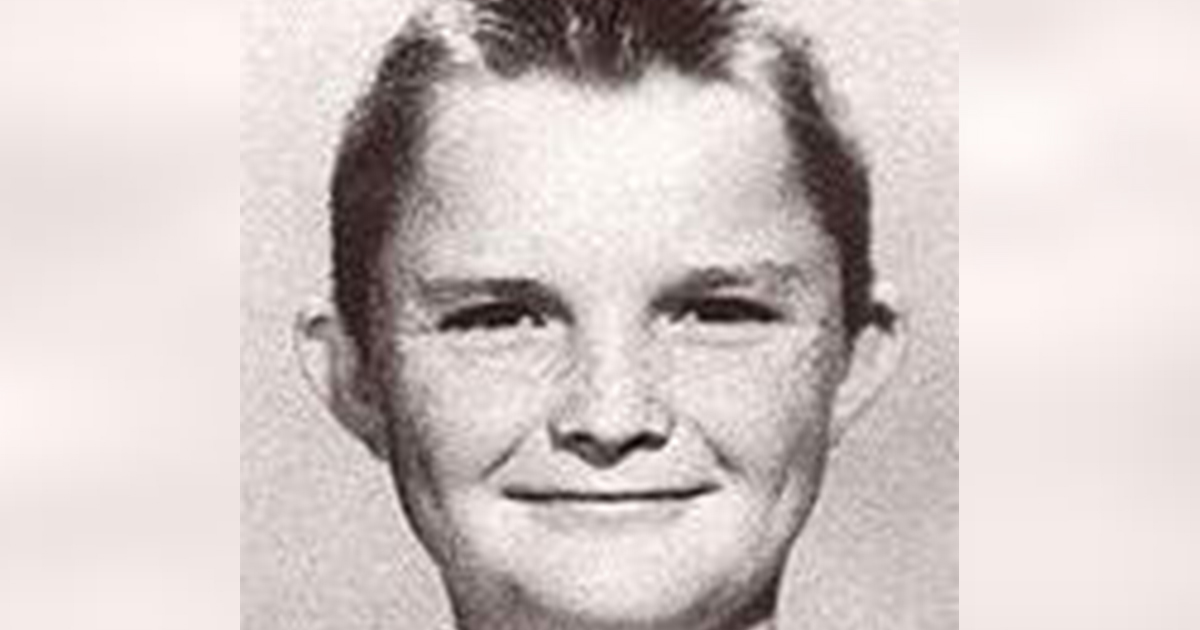
The Smiling Boy Who Became One of America’s Most Prolific Killers
The topic of America’s Most raises many questions. It is a difficult truth to confront: every notorious figure in criminal history was once a child, innocent and unmarked by the darkness they would later embody. The photograph of a young, smiling boy, captured in a moment of ordinary childhood, offers no hint of the monstrous path that lay ahead.
That boy, born into a modest California family, would eventually become one of the state’s most feared predators. Over a span of twelve years, he is believed to have claimed the lives of more than fifty young men and boys, leaving a trail of grief and terror that continues to haunt investigators and families to this day.
A Childhood of Order and Silence
Born on March 19, 1945, in Long Beach, California, he was the only son in a working-class household that had relocated from Wyoming. To neighbors and classmates, the family appeared to be living the postwar American dream in the new suburbs of Southern California. Their pale-blue house seemed unremarkable, yet those who visited often noted an unusual quietness that hung in the air.
The boy was intelligent and observant, with a reputation for being polite and reserved. He excelled in school, showing a particular aptitude for puzzles and mathematics. Teachers praised his obedience and bright mind, while his mother doted on him and his father, a factory worker, instilled a strict expectation of discipline.
Those who knew the family recall how immaculate his room was, how his belongings were always arranged with precision. Even in childhood, he displayed a deep need for control, a trait that would later manifest in the most horrifying ways imaginable.
The High School Years
When the family settled in Westminster, Orange County, the young man adapted easily to the conservative environment of the 1950s. High school classmates remembered him as smart, clean-cut, and quiet. He was academically successful and held political views that were staunchly traditional, with one acquaintance describing him as politically “somewhere right of Attila the Hun.”
He participated in student government and the debate team, appearing destined for a respectable and conventional life. After graduating in 1963, he enrolled at Claremont Men’s College to study economics. He became active in campus politics, campaigning for Barry Goldwater and voicing support for the Vietnam War.
However, by his junior year, those around him noticed a significant change. He grew a beard, his political views softened, and he began attending anti-war rallies. More privately, he was beginning to confront a part of his identity he had long suppressed.
By 1969, he had come out as gay, a revelation that shocked his family and led to his discharge from the Air Force Reserve. The official reason given was medical, but the underlying cause was his sexuality.
A Descent into Darkness
After leaving the military, he remained in Southern California, taking on various jobs, including bartending and computer programming. He was articulate, well-dressed, and courteous, presenting himself as a mild and urbane individual with an IQ of 129. Yet beneath this calm facade, something was deteriorating.
He began experimenting with drugs, particularly amphetamines and barbiturates, and developed a heavy reliance on alcohol. Friends started to notice erratic behavior, including periods of isolation, sudden bursts of anger, and unexplained absences.
The vibrant coastal nightlife of Long Beach and Sunset Beach attracted him, particularly the gay bars that served as gathering places for those living in secrecy. He worked at one such establishment, engaging easily with the regulars. But he was also observing, waiting, and testing boundaries.
The First Known Incident
In March 1970, a frightened and disoriented 13-year-old runaway named Joseph Fancher stumbled into a Long Beach bar, barefoot and incoherent. Police determined that he had been drugged and attacked by an older man who had offered him shelter. A suspect was identified, and a search of his apartment uncovered the boy’s shoes along with a cabinet full of sedatives.
However, the case collapsed when the evidence was thrown out due to a warrantless search. The man walked free, and the incident was largely forgotten. It would later be recognized as the first known act in a campaign of violence that would span more than a decade.
A Pattern of Terror
In the years that followed, a grim pattern emerged across Southern California. Young men, often in their teens or early twenties, frequently Marines or hitchhikers, began to disappear. Their bodies were later discovered along highways, in ravines, and in remote fields.
The killings were characterized by extreme brutality. Victims were drugged, restrained, and killed with chilling precision, with many showing signs of sustained torture. Investigators from multiple counties eventually realized they were dealing with a single, highly mobile predator who seemed to operate along the freeway system.
By 1975, police had connected several of the cases but had no viable suspect. They were unaware that the killer was living comfortably in Long Beach, employed as a computer programmer and spending his weekends hunting for victims. Between 1971 and 1983, he is known to have kidnapped, tortured, and murdered at least sixteen men and boys, though the true number is believed to be far higher.
A Fateful Traffic Stop
On a spring night in May 1983, chance intervened. Shortly after 1:00 a.m., two California Highway Patrol officers stopped a Toyota Celica on the 405 Freeway near Mission Viejo. The driver appeared intoxicated, with a half-empty beer bottle beside him.
When an officer looked toward the passenger seat, he discovered the body of a young Marine named Terry Gambrel. His belt was wrapped around his neck. The driver’s license identified him as Randy Kraft, a name that would soon become infamous. The press would later call him “The Scorecard Killer.”
During the traffic stop, officers found a briefcase containing drugs, alcohol, and a notebook. A subsequent search of his home uncovered photographs, personal belongings of victims, and evidence linking him to murders stretching from California to Oregon. The most disturbing discovery, however, was a neatly written list containing more than sixty cryptic entries.
Decoding a Record of Death
The list contained short, coded phrases such as “Stable,” “Marine Drum,” “Iowa,” and “Parking Lot.” Initially, these seemed meaningless, but detectives soon realized they were looking at a record of his crimes, with each line representing a victim.
One entry, “Stable,” was believed to reference the bar where Kraft had worked. Another, “Airplane Hill,” matched the location where a body had been discovered near an airfield. The list was a meticulous chronicle of horror, spanning more than a decade. He had documented each life taken as if it were a statistic, another act of control.
His victims were predominantly young white men, mostly in their late teens or early twenties, many with drugs or alcohol in their systems. His method was consistent: he would offer them drinks laced with sedatives, and once they were unconscious, he would commit unspeakable acts. Many victims were found unclothed, bearing the marks of methodical torture.
The photographs discovered in his possession were among the most haunting evidence. Victims were posed with eerie precision, some appearing to sleep, others unmistakably lifeless. These Polaroids became a defining piece of the prosecution’s case.
A Double Life
The arrest of Randy Steven Kraft stunned his friends and colleagues. One close friend described him as “a normal kid, just like everybody else.” To the outside world, he was a loyal friend, a devoted family member, and a talented computer expert. A former classmate who once had a crush on him remarked that everyone liked him.
In 1989, following one of the longest and most expensive trials in Orange County history, Kraft was convicted of sixteen murders, as well as multiple counts of sodomy and torture. In his defense, he offered only a single statement, asserting that he had not murdered anyone and that a reasonable review of the record would show this. He then sat down calmly and poured himself a glass of water.
When the verdict of death was read, Kraft showed no emotion. He was sent to San Quentin’s death row. Relatives of his victims reacted with a mix of relief and anguish. Some wept, others smiled, and one grieving father shouted for him to burn in hell as he was led away. The father of another victim noted that even after an execution, the anger would remain.
The news of the arrest sent Kraft’s family into hiding from the press. His attorney at the time acknowledged that the situation had been devastating for them, but noted that they still loved him and had remained devoted since his arrest.
An Unrepentant Silence
In over four decades behind bars, Kraft has never admitted to a single killing. Detectives continue to believe there are dozens more victims who remain unidentified. In 2012, retired homicide detective Dan Salcedo met with Kraft inside San Quentin, hoping for a confession or a clue about unsolved cases.
Salcedo described Kraft as unremarkable in appearance, noting that he would be the last person one would pick out of a crowded room as a killer. He felt no aura of evil when looking into Kraft’s eyes, only a bitter old man. The interview ended without any new information, and Kraft was led away.
Salcedo later reflected on the encounter, describing it as an example of the banality of evil. He noted that Kraft looked like a neighbor or coworker, with nothing about him suggesting danger, which he found to be the most terrifying aspect.
America’s Most: An Ongoing Legacy of Pain
Even today, investigators revisit unsolved murders, searching for connections to the cryptic entries on Kraft’s list. Some families have finally found answers through advances in DNA testing, while others still wait for closure that may never come.
Kraft now spends his days confined to a small cell, aging, silent, and unrepentant. He is a man who maintained order in every aspect of his life except his soul. His conviction and death sentence were upheld by the California Supreme Court on August 9, 2000. As of 2025, he remains on death row at the California Institution for Men in San Bernardino County, continuing to deny any involvement in the murders for which he was convicted or the many others he is suspected of committing.
